



Background Image
Background Image
Background Image
Background Image

Cybersecurity B2B | 2024 - 2026

My contribution

UX Writing

Voice Developement

Design Specs

Vibe Coding

Teaching a Product to speak and a team to talk like it

No shared voice, no guidelines, no consistency – so we fixed all three.

Cybersecurity B2B | 2024 - 2026

My contribution

UX Writing

Voice Developement

Design Specs

Vibe Coding

Teaching a Product to speak and a team to talk like it

No shared voice, no guidelines, no consistency – so we fixed all three.

Summary

From bottleneck to shared practice

For our security platform, language had long been secondary to technical features. Texts were inconsistent, terminology kept shifting, and there was no shared agreement on how the product should communicate. Usability tests showed that users struggled to understand the interface, sometimes even our own teammates.

Over time I became the team's default UX writer. Colleagues would send me microcopy to review or ask me to write it from scratch. It worked, but it didn't scale. Without a defined voice, agreed terminology every text felt like starting from zero. I needed to improve that.

What's better now

A defined voice the whole team agrees on

A defined voice the whole team agrees on

Clear guidelines that make it actionable

Clear guidelines that make it actionable

An AI tool that lets everyone write consistently

An AI tool that lets everyone write consistently

Process

Research-based, MVP-minded

Rather than turning this into a lengthy theoretical exercise, I focused on building something that could be used immediately. Starting with an audit of existing texts, I looked at how comparable B2B products handle voice and tone, cross-referenced our brand identity, and grounded everything in UX writing principles.

An AI served as a creative sparring partner throughout – to stress-test principles, simulate workshop participation, and pressure-check whether the guidelines would hold up in practice.

The result grew iteratively: from a defined voice framework, to a Claude skill that puts it directly in anyone's hands, to a tool that scales the practice across the whole team.

Outcome #1

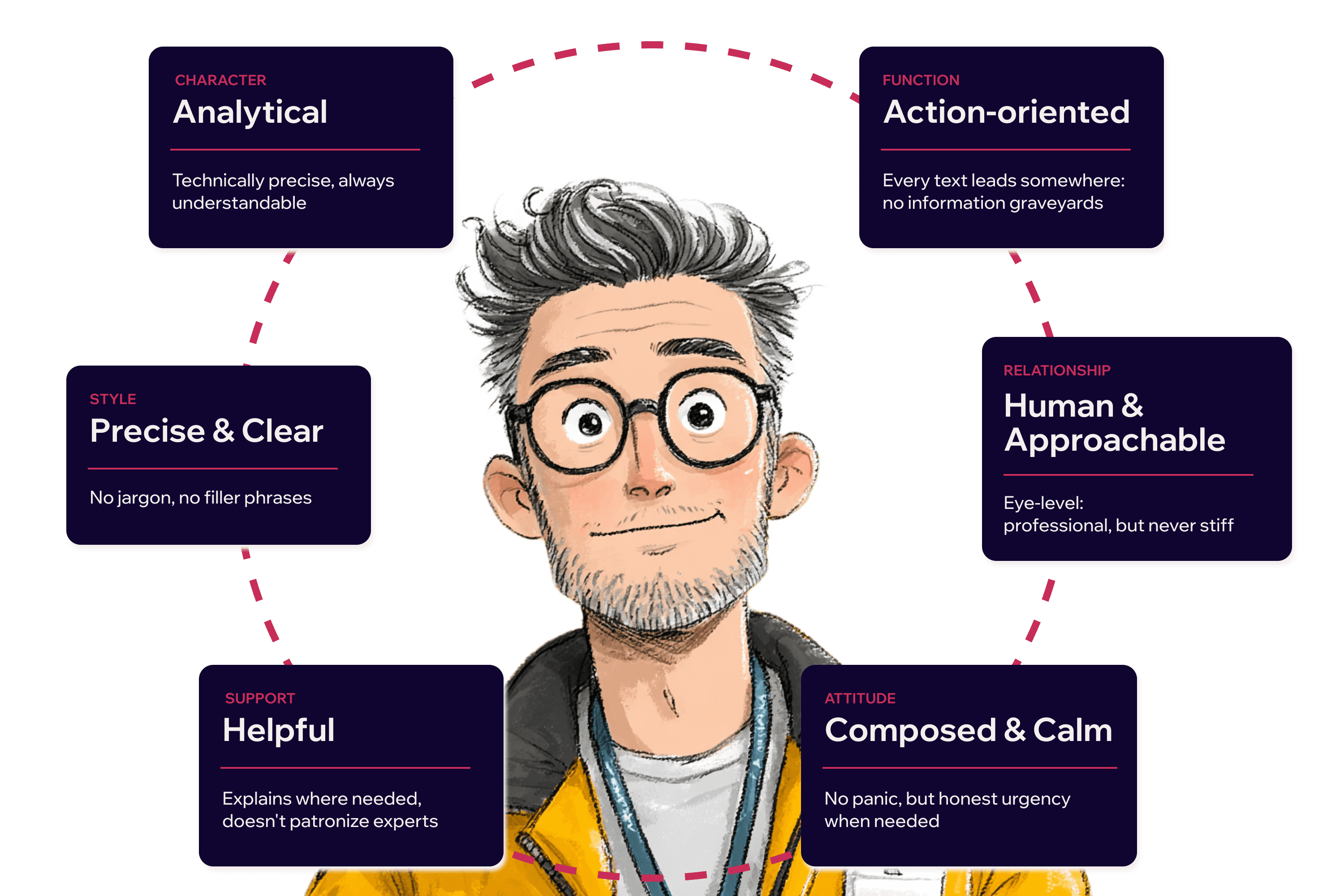
The Voice: Clear, calm and human

The result is a defined voice with clear guidance on how to apply it – capturing the personality of the product, the principles behind every writing decision, and the boundaries that keep language consistent without making it sound robotic.

Gaja speaks like an experienced IT security expert. Precise, clear, and at eye level. It explains without lecturing. It warns without alarming. It's the colleague you trust because they stay calm when it counts.
Outcome #2

Turning the voice into actionable guidelines

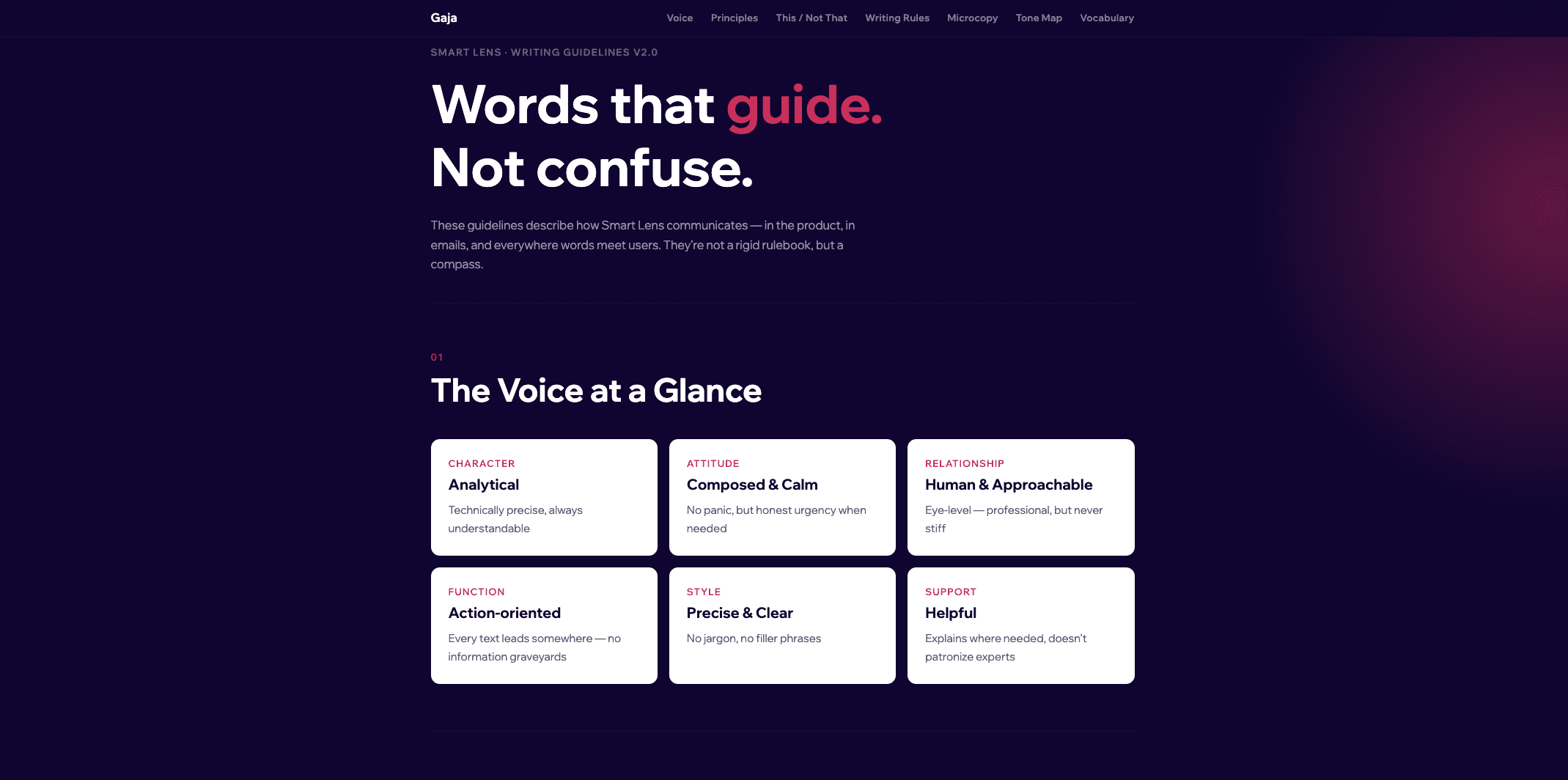
Defining a voice is one thing. Making it usable for a whole team is another. The guidelines translate every principle into concrete rules – with examples and clear dos and don'ts for every writing situation. The goal: Words that guide, not confuse.

Outcome #3

No one reads guidelines. So I built a tool instead.

Not everyone has the time or instinct for language to work with wording documentation. The tool puts the voice directly in the hands of everyone who writes – no guidelines required.

My role shifted from rewriting everything to reviewing the output.
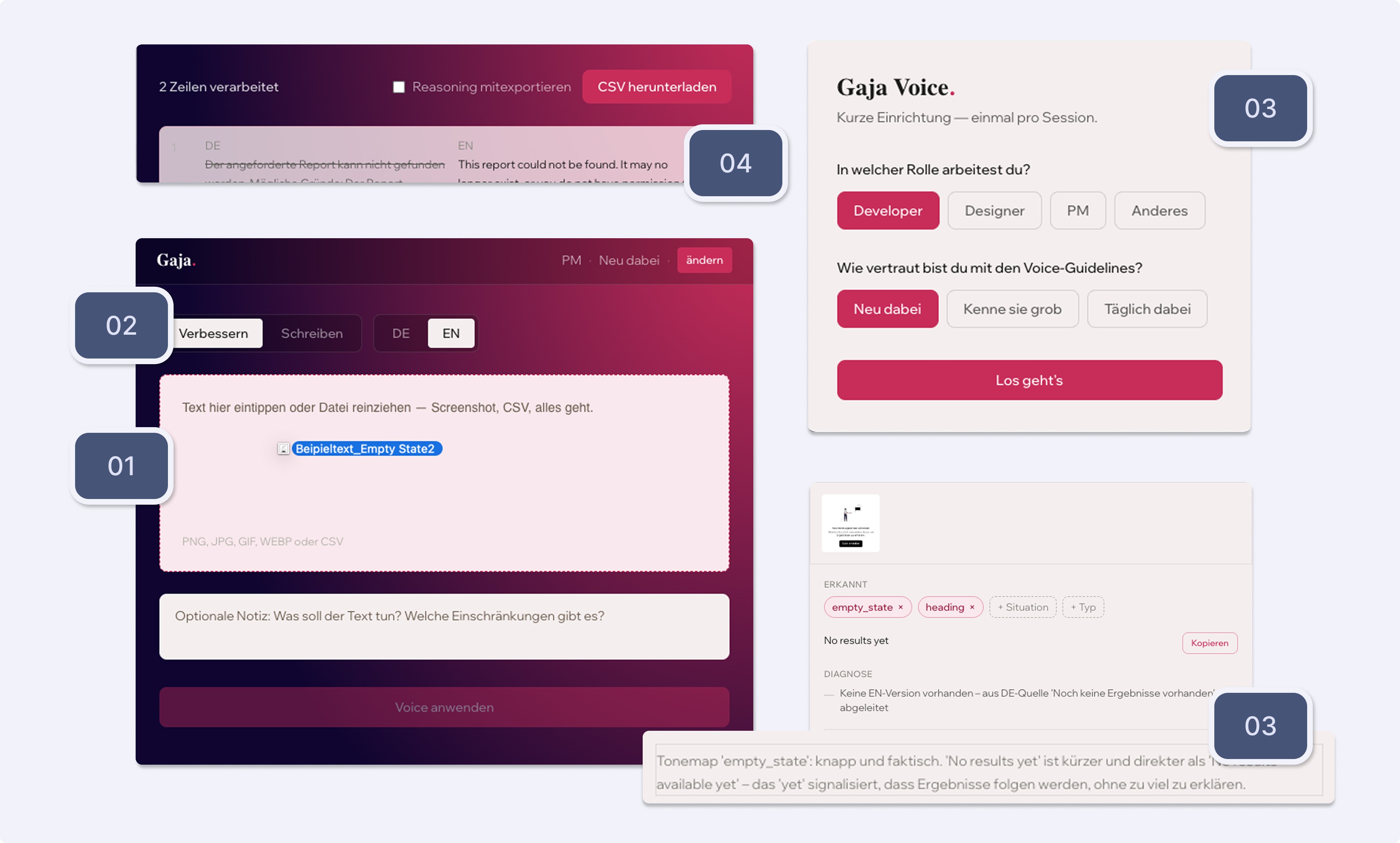
01 – Drop it in

Text, screenshots, CSV – drag and drop, no manual prep needed.

02 – Manual override

Language and processing mode are set automatically. Change them anytime if needed.

03 – Set your level and learn as you go

Your role and experience shape the output – more reasoning for beginners, less for experts. Change it anytime.

04 – Batch processing included

Drop in a CSV and the tool rewrites entire tables in one go.

Learnings

What I take away

Defining voice is the easy part.

Capturing how a product should sound comes quickly. Turning that into consistent copy, case by case, is where the real work begins. "This but not that" helps more than any principle alone.

Defining voice is the easy part.

Capturing how a product should sound comes quickly. Turning that into consistent copy, case by case, is where the real work begins. "This but not that" helps more than any principle alone.

Voice works in details and in context

The right word in the right place make products work and builds trust. The overall feeling users get only emerges when all the details work together consistently across the product.

Voice works in details and in context

The right word in the right place make products work and builds trust. The overall feeling users get only emerges when all the details work together consistently across the product.

A tool gets used, guidelines don't.

Colleagues are far more likely to use a tool than read a style guide, which cuts the writing bottleneck significantly. But automated output still needs a human review for context and tone.

A tool gets used, guidelines don't.

Colleagues are far more likely to use a tool than read a style guide, which cuts the writing bottleneck significantly. But automated output still needs a human review for context and tone.

Judith Schmeier | Senior UX Designer - Product & Usability

based in Augsburg | looking for Jobs here or nearby

hello@schmeierhaft.de

© 2026 Judith Schmeier All rights reserved

Judith Schmeier | Senior UX Designer - Product & Usability

based in Augsburg | looking for Jobs here or nearby

hello@schmeierhaft.de

© 2026 Judith Schmeier All rights reserved

Judith Schmeier | Senior UX Designer - Product & Usability

based in Augsburg |
looking for Jobs here or nearby

hello@schmeierhaft.de

© 2026 Judith Schmeier All rights reserved